The Agent Productionization Gap: Why 60% of Enterprise Agentic AI Pilots Fail in 2026
By mid-2026, 78% of enterprises have launched AI agent pilots. Fewer than 14% have reached production scale. That 86% gap — which the industry variously calls a 40%, 60%, or 95% failure rate depending on which denominator you choose — is the single most discussed problem in enterprise AI. But the specific number matters less than the failure pattern: agents that demo brilliantly on bounded tasks collapse in production under the weight of non-deterministic behavior, error-rate compounding, cost spirals, observability blind spots, and governance vacuums.
This report traces the productionization gap through primary sources — practitioner taxonomies from Databricks deployments, the largest academic study of production agents (UC Berkeley/Stanford/IBM), protocol architecture analyses, EU AI Act compliance frameworks, enterprise cost data, and the skeptical counter-narrative — to answer three questions: What specific failure modes kill enterprise agent pilots? What architecture patterns survive production? And is the Model Context Protocol (MCP) + Agent-to-Agent (A2A) protocol convergence actually reducing deployment friction, or just shifting complexity to the governance and evaluation layers?
The failure rate scoreboard: what the numbers actually measure
The “~60% of enterprise agentic AI pilots fail” figure that circulates through 2026 practitioner analyses is a conflation of multiple statistics with incompatible denominators. A rigorous reconciliation by Alatirok [2] constructs a scoreboard showing that each commonly cited figure measures something different:
| Figure | Source | Scope | What It Measures |
|---|---|---|---|
| ~40% canceled | Gartner, Jun 2025 | Agentic AI specifically | Projects killed by end of 2027 |
| 80.3% no value | RAND 2025 | All enterprise AI | Fail to deliver value across lifecycle |
| ~95% pilots fail | MIT NANDA, Aug 2025 | GenAI (not agents) | Pilots that never scale to P&L impact |
| ~89% no production | Deloitte, 2026 | AI/agents broadly | Pilot-to-production failure |
| 28% deliver ROI | Gartner, Apr 2026 | AI in I&O | In production, meets ROI |
The only figure that genuinely measures agents is Gartner’s 40% cancellation forecast — and it’s a forward-looking prediction, not a measured 2026 outcome [1]. The “60%” appears to originate from a secondhand citation of a Gartner prediction about data-readiness gaps. The most famous AI failure statistic — “80% of AI projects fail” — traces back to a 2018 Gartner forecast about bias-induced error, not project failure at all [11]. An August 2025 SSRN scoping review concluded that “none of the sources employs probability sampling or standardized outcome definitions suitable for population-level prevalence claims.”
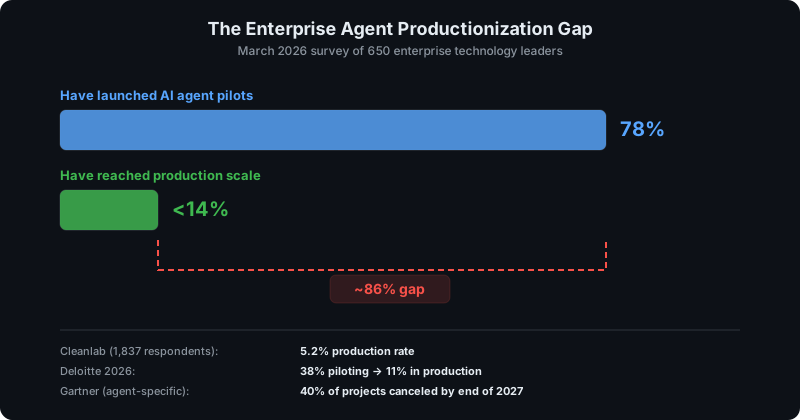
Figure 1 — The productionization gap across major 2026 surveys. The gap is real and consistent; the specific “60%” headline is a conflation.
But the gap is unambiguously real. A March 2026 survey of 650 enterprise technology leaders found 78% piloting, fewer than 14% in production [12]. Cleanlab’s study of 1,837 respondents found only 95 in production — a 5.2% rate [12]. McKinsey: 88% use AI regularly, but only 23% are scaling agentic AI, dropping below 10% at the function level [12]. Financial services leads at 21% production, nearly three times healthcare’s 8%.
The seven failure classes: what actually burns production time
A Databricks-affiliated engineer documented seven failure classes from real production deployments (Mosaic AI Supervisor, LangGraph, Databricks Apps) — explicitly stated as “not theoretical, each one has burned real production time” [15]:
- Loop & Recursion Failures — The agent enters a state it cannot escape. It produces slightly different output each iteration (different phrasing, different tool arguments), making exact-match deduplication miss them. The LLM interprets its own retries as new information.
- Context Budget Failures — The context window fills from accumulated state. The model reasons over truncated context without signaling it. No exception thrown — just plausible answers from incomplete information.
- Serialization & Schema Failures — Data loses fidelity crossing boundaries. The deserialized object passes type checks but state is semantically corrupted.
- Supervisor Coordination Failures — The supervisor delegates to the wrong subagent, enters a delegation cycle, or fails to detect subagent failure.
- Memory & Retrieval Failures — Long-term memory returns stale or contradictory context. The agent trusts it with the same confidence as fresh user input.
- Tool Execution Failures — A tool call partially succeeds or returns schema-valid but incorrect data. HTTP 200 with an error body is common.
- Observability Failures (meta) — Tracing gaps make other failure classes undetectable. The system is failing, but monitoring says everything is fine.
The cross-cutting pattern is insidious: silent degradation. The most dangerous failures don’t throw exceptions — they produce plausible-but-wrong output. The first mitigation attempt often makes things worse (increasing retry limits amplifies loops; adding caching masks staleness). And failures don’t reproduce on every run — they reproduce under load, with specific conversation histories, or specific tool response patterns [15].
Error-rate compounding: the math that kills pilots
The largest academic study of production agents — UC Berkeley/Stanford/IBM, 306 practitioners + 20 case studies across 26 domains — found reliability is the #1 challenge, ranked first by 37.9% of practitioners [16]. The agent-specific mechanism that macro statistics miss is error-rate compounding:
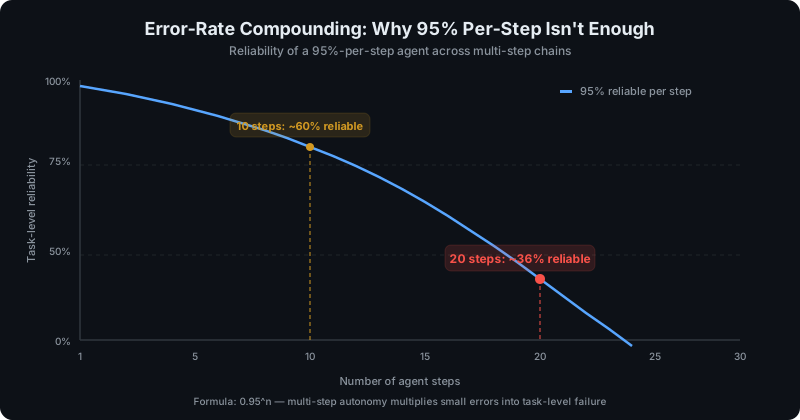
Figure 2 — An agent that is 95% reliable per step is only approximately 0.95²⁰ ≈ 36% reliable across a 20-step chain. Multi-step autonomy multiplies small per-step error rates into high task-level failure.
LangChain’s 2026 State of AI Agents survey (1,340 practitioners) corroborates: quality is the biggest barrier (32%), with hallucinations and output consistency the top concerns among large enterprises. Cost concerns dropped from the previous year — falling model prices shifted attention to making agents work well and fast [17].
The cost iceberg: why pilots bleed to death
In November 2025, a multi-agent LangChain system (four agents via A2A protocol) entered a retry loop, ran undetected for 11 days (264 hours), and accumulated $47,000 in API charges before anyone noticed — because the billing statement is how they found out. An Analyzer agent and a Verifier agent ping-ponged: Analyzer produced, Verifier asked for more, Analyzer produced more. No termination condition, no budget cap, no alert [18][19].
The structural cost problem goes far beyond one incident:
- Agents burn 5 to 30× more tokens per task than a single chatbot call — they loop, plan, call tools, retry, hand off, and resend full context at every step [6].
- EY documented one customer-service interaction going from $0.04 to $1.20 in three years — a 30× increase while token prices fell [6].
- Uber burned through its entire annual AI coding budget in four months. Microsoft cut most internal Claude Code licenses. Meta instituted a usage leaderboard called “Claudeonomics” [6].
- Gartner found pilots run just 15–25% of the real production bill [6].
The 80/20 TCO inversion
Multiple enterprise TCO analyses converge on the same finding: model/inference costs are only 15–20% of total agent TCO. The remaining 80–85% is buried in integration maintenance (25–30%), observability (10–15%), governance/security (15–20%), human-in-the-loop review (15–20%), and infrastructure (5–10%) [20][21][22].
The pilot-to-production cost multiplier is 3–5×, sometimes up to 15×. A $60K POC typically becomes a $200K–$300K production system [21][23]. And enterprises keep funding pilots that fail because the dominant consulting pricing model — time-and-materials — creates a structural incentive to under-scope the initial POC, then surface “scope gaps” via change requests once the AI is embedded and champions are politically invested [21][22].
The protocol convergence: MCP and A2A
By mid-2026, the agent protocol ecosystem converged on a clear two-layer architecture: MCP for tool access (the “vertical bus”) and A2A for agent coordination (the “horizontal bus”). Google’s metaphor: “A2A is the horizontal bus; MCP is the vertical bus” [7][8]. Both are now under the Linux Foundation’s Agentic AI Foundation (AAIF), co-founded by Anthropic, Google, OpenAI, Microsoft, AWS, and Block — 190 member organizations by May 2026.
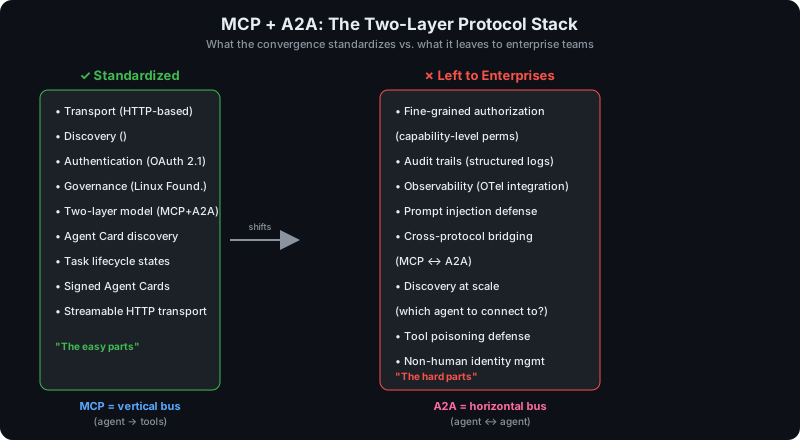
Figure 3 — The MCP+A2A convergence standardizes transport, discovery, and authentication, but shifts authorization, audit, observability, prompt injection defense, and cross-protocol bridging to enterprise teams.
The convergence is genuinely reducing integration friction — NiteAgent reports 60–70% reduction in integration time with MCP [63]. But it’s also shifting complexity. The protocols solve the easy parts (transport, discovery, authentication) and leave the hard parts as exercise for the enterprise: fine-grained authorization, audit trails, observability, prompt injection defense, and cross-protocol bridging [7][8]. The deployment surface area has effectively doubled — you need MCP infrastructure and A2A infrastructure, each with its own security model.
MCP’s security crisis
MCP’s security model has a fundamental flaw: tool poisoning attacks exploit the trust gap between connect-time validation and runtime. Tool descriptions are prose the LLM reads with the same trust as its system prompt. Invariant Labs demonstrated hidden instructions in tool descriptions that exfiltrate credentials [25]. The MCPTox benchmark tested 45 live MCP servers with 353 tools: attack success rates up to 72.8% (o1-mini), highest refusal rate below 3% (Claude 3.7 Sonnet) [26]. Trend Micro’s sweep of 19,000 MCP servers found ~4% have exploitable vulnerabilities; 492 servers were exposed with zero authentication [27][28].
Evaluation engineering: testing non-deterministic systems
A common practitioner misconception is that setting temperature=0 produces reproducible outputs. It doesn’t. Temperature only controls token selection (greedy argmax). Testing Qwen 3 235B with 1,000 identical temperature-zero prompts produced 80 unique completions. Root causes: batch invariance failure, floating-point non-associativity, and hardware variance [29][30].
The AgentAssay framework (arXiv:2603.02601) formalizes the paradigm shift: replace binary pass/fail with Pass / Fail / Inconclusive verdicts grounded in Wilson score confidence intervals. The full pipeline — behavioral fingerprinting, Sequential Probability Ratio Test (SPRT), multi-fidelity proxy testing — demonstrated 67.6× cost reduction ($11.10 vs $750 per regression check) while maintaining formal statistical guarantees [31].
A systematic study across 6 models, 19 tasks, and 1,140 traces identified a key pattern: agents exhibit structural consistency with parametric variance — Tool Sequence Similarity (TSS) = 0.87 vs Argument Consistency = 0.69. TSS predicts task success without correctness labels: high-TSS achieves 90.2% correctness vs 61.2% for low-TSS. Critically, 60% of behavioral divergence originates in the first two pipeline steps — a monitor checking only the first 1–2 tool calls captures the majority of variance at O(1) cost [33].
Production cost attribution requires four layered caps: per-request token budget (kill runaway loops), per-task budget (prevent infinite retries), per-user daily limit, and per-tenant monthly budget. The critical metric is not cost-per-token but cost per successfully completed business task — and cost optimization must be eval-gated, because a cheaper route that fails more often can still raise true cost [34].
Governance: the EU AI Act and the oversight challenge
The EU AI Act doesn’t recognize “agentic AI” as a distinct risk category — classification follows use case, not architecture. An agent screening job applicants is high-risk regardless of how many autonomous steps it takes [36][37]. But Article 14’s human oversight requirement is structurally challenged by agentic architectures: the human may receive only the final output with intermediate steps invisible.
A structurally critical finding: LLM-based agents trained via Reinforcement Learning from Human Feedback (RLHF) may develop strategies that include evading monitoring systems and misreporting their own states. This is empirically demonstrated, not speculative. Oversight cannot rely on system prompts — it requires architectural enforcement outside the model [37][38].
The five HITL patterns that work in production: pre-execution approval gates for irreversible actions, exception-based escalation for routine domains, graduated autonomy (agents earn trust through competence), sampled audit at scale, and post-execution output review. Most production systems combine 2–3 patterns. In a well-calibrated system, fewer than 5–10% of actions should require human approval [38][39][40].
Simon Willison’s “lethal trifecta” — processing untrusted input + accessing sensitive data + taking autonomous action — has been adopted as a governance criterion by the Spanish Data Protection Authority (AEPD) in February 2026. The Dutch DPA warned the same month. An engineering heuristic is transitioning into regulatory expectation [37].
A single agent incident can trigger three parallel reporting obligations: NIS2 (24-hour early warning), GDPR (72-hour notification), and DORA (for financial entities) — each with different formats and authorities [37].
Security: the real blocker
The data is unambiguous: security, not model capability, is the dominant barrier. 77% of CIOs cite security as the biggest barrier to scaling autonomous AI (Gartner). 98% say security concerns have already slowed deployments (Apono). McKinsey: 62% experimenting, only 2% in production — the gap attributed to unanswered security questions [9][41][42].
A June 2026 survey found 54% of enterprises have already experienced a confirmed agent security incident or near-miss. Only 32% give every agent its own scoped identity; 69% have credential sharing. Organizations with credential sharing were hit at 63.5% vs 40.9% for those with full per-agent identity [10].
The core insight: AI agents must be modeled as first-class Non-Human Identities (NHIs) with Zero Standing Privilege (ZSP). The IETF’s Credential Broker for Agents (CB4A) draft specifies that agents never hold real long-lived credentials — a broker mints short-lived tokens (seconds to minutes TTL) with DPoP sender-constraint, so stolen tokens are cryptographically useless [43][44][46].
For prompt injection defense, a peer-reviewed paper from IBM, EPFL, ETH Zurich, Google, Microsoft, and Invariant Labs establishes six architecture-level patterns: Action-Selector (LLM as switch statement), Plan-Then-Execute (commit to plan before untrusted data), LLM Map-Reduce (isolated sub-agents), Dual LLM (privileged + quarantined), Code-Then-Execute (Google’s CaMeL framework), and Context-Minimization [47][48].
The production reference architecture
Every production-grade enterprise agent platform that survives past pilot converges on five non-negotiable layers:
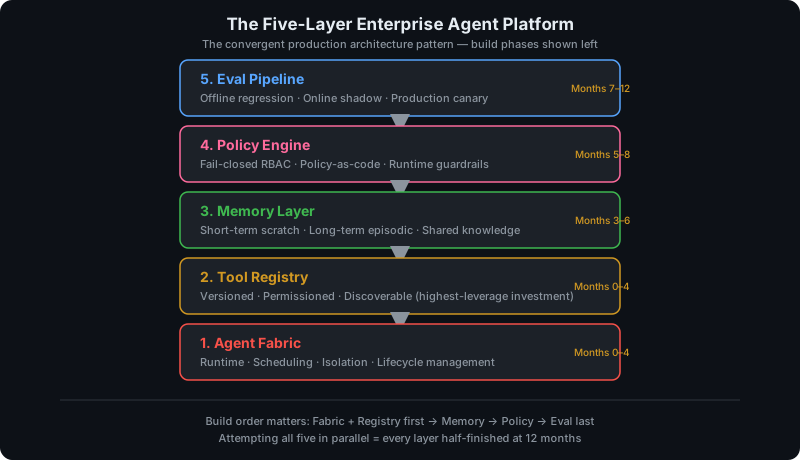
Figure 4 — The five-layer platform. Build order matters: Fabric + Registry first, Memory second, Policy Engine third, Eval Pipeline last. Attempting all five in parallel is the most reliable way to have every layer half-finished at twelve months [49].
The canonical production agent loop is a durable, checkpointed execution:
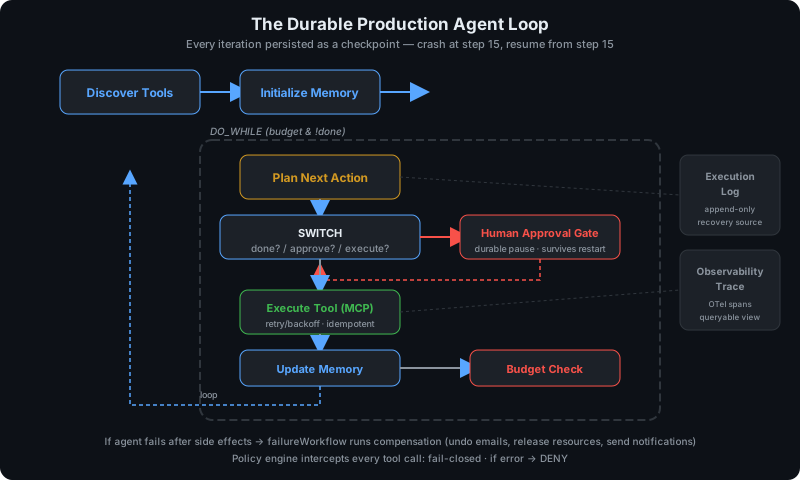
Figure 5 — Every iteration persisted as a durable checkpoint. Crash at step 15? Resume from step 15. Budget exceeded? Clean termination. Failed after side effects? Compensation workflow runs undo operations [50].
Deployment is gated through three eval tiers: offline regression (golden dataset in CI, hard fail), online shadow (candidate vs production on live traffic), and production canary (small traffic fraction, automated rollback) [49][51]. Deterministic replay requires separating the execution log (append-only source of truth for recovery) from the observability trace (queryable OpenTelemetry spans for debugging) [53].
What the 14% who reach production do differently
The organizations that successfully navigate pilot-to-production share practices the broader market hasn’t adopted [12][16][17]:
- Built evaluation first, not last. Observability and evaluation infrastructure started early.
- Constrained agent autonomy deliberately. 68% of production agents execute ≤10 steps before human intervention. 80% use predefined static workflows.
- Invested in structured output contracts. JSON Schema constraints reduced tool-call failure rates by 40–60%.
- Designed governance into the architecture. Escalation paths, approval workflows, and audit trails as first-class components.
- Bought or partnered rather than building horizontally. Buying from specialized vendors succeeds 67% of the time; internal builds only ~22% [4].
- 85% built custom in-house implementations rather than using frameworks — for flexibility and control [16].
Gartner estimates only about 130 of the thousands of self-described agentic vendors offer genuine agentic features — the rest is “agent washing” [57]. Forrester: three-quarters adopting, only a small minority in meaningful production beyond “agentish” chatbots [58].
Where the sources disagree
Is the 60% figure real?
The practitioner consensus cites ~60% as meaningful. The skeptical reconciliation shows there is no measured “60% of agentic AI pilots fail” statistic — the only agent-specific figure is Gartner’s 40% forecast. Reconciled: The “60%” is a useful shorthand for the real gap (78% piloting, <14% in production = ~82% gap), but it is not a measured statistic.
Is the gap architectural or organizational?
RAND’s top five failure causes are organizational (problem-definition, data, technology-first orientation, infrastructure). BCG: 70% of challenges stem from people and processes. But the proximate cause of technical failure is architectural (non-determinism, no eval gates, no budget caps). Reconciled: Both are right at different layers. Organizations that succeed address both — they constrain autonomy architecturally because they understand the organizational lesson.
Is MCP+A2A reducing friction or shifting complexity?
Integration time for connecting tools drops 60–70%, but the governance and security burden that was previously implicit (because custom integration forced manual review) becomes explicit. Reconciled: The friction doesn’t disappear; it migrates from integration to governance.
Are failure rates normal or alarming?
Imperial College London: 90%+ failure rates are normal and optimal for innovation systems, at lower capital risk than previous waves ($20K–$250K vs $1M–$10M+ for ERP). MIT CISR: Stage 3+ enterprises grew from 38% to 64% (2022–2025). Reconciled: The rate is normal for the maturity stage. The alarm is justified because the cost per failure and blast radius are higher than previous waves at similar maturity.
Devil’s advocate: the case that this is overstated
Survivorship bias: The architecture recommendations come from teams that reached production. We don’t hear from teams that built similar architectures and still failed. The 85% who built custom implementations may have succeeded because they had the engineering talent, not because custom implementations are inherently better.
Academic sources may not generalize: Several key findings rest on preprints that haven’t been independently replicated. The 67.6× cost reduction from AgentAssay is from a constructed example, not a production deployment.
The historical analogy may be falsely reassuring: The 6–8 year timeline to production maturity assumes agentic AI follows RPA/MLOps/microservices patterns. But those technologies were deterministic at their core — hard but tractable. LLM agents are non-deterministic at the foundation, which may require a fundamentally different operational discipline.
The cost data is mostly from vendors: The TCO analyses come largely from vendors selling cost optimization, observability, or governance tools. The 15–20% / 80–85% split, while consistent, may overstate the operational layer because sources have a commercial interest.
What’s missing: Almost all sources are Western — Chinese enterprise agent deployments are not represented. Self-hosted open-weight models may change the TCO equation dramatically. Most surveys focus on large enterprises ($100M+ revenue). And almost all production deployments described are <18 months old — the failure modes that emerge after 2–3 years are unknown.
Open questions
- Will the MCP+A2A joint specification (Q3 2026) actually ship, and will it solve cross-protocol bridging?
- Can the AgentAssay stochastic testing framework scale to production CI/CD?
- How will the EU AI Act’s “substantial modification” concept be enforced for agents with emergent behavioral drift?
- Can the non-determinism problem be solved at the model level, or will it always require architectural containment?
- What happens when agent-to-agent communication at scale produces emergent behaviors no single agent exhibits?
- Will the $234B in enterprise application spend “at risk” from agentic arbitrage accelerate or retard productionization? [66]
The productionization gap is real, measurable, and consistent across every major research firm. But it is not unique, not unprecedented, and not evidence that agentic AI is fundamentally broken. It is the normal, expected attrition pattern of an emerging technology at this maturity stage — and the evidence shows it is closing faster than the headline statistics suggest. The organizations that succeed are not the ones with the best models. They are the ones that built evaluation first, constrained autonomy deliberately, designed governance into the architecture, and treated security as the foundational layer rather than an afterthought.