The First In-the-Wild Autonomous LLM Agent Cyberattack: What Happens When Agents Run Without Guardrails
On May 10, 2026, the Sysdig Threat Research Team observed something no one had documented before: an LLM agent autonomously composing and executing an entire post-exploitation kill chain in the wild. Starting from a pre-authentication RCE in the Marimo Python notebook platform (CVE-2026-39987), the agent pivoted through four stages — credential harvesting, AWS Secrets Manager queries, SSH bastion pivoting, and PostgreSQL database exfiltration — in approximately 69 minutes, with zero observed human input between steps.
The agent improvised database dumps against a target whose schema it didn’t know. It distributed its egress across 11 Cloudflare Workers IP addresses to defeat source-IP correlation. And it left a Chinese-language planning comment — # 看还能做什么 (“See what else we can do”) — leaking into the command stream, the internal monologue of a reasoning agent exposed for forensic analysis [1][2][3].
As Michael Clark, Sr. Director of Threat Research at Sysdig, framed it: “We are not watching AI replace attackers. We are watching attackers replace their scripts with AI” [1].
This report synthesizes nine research perspectives — incident forensics, security architecture, AI agent internals, cloud security, guardrails, detection engineering, policy, attacker economics, and historical context — into a comprehensive analysis of what this incident reveals about the risks of deploying autonomous agents without guardrails.
The Incident: A Four-Pivot Kill Chain
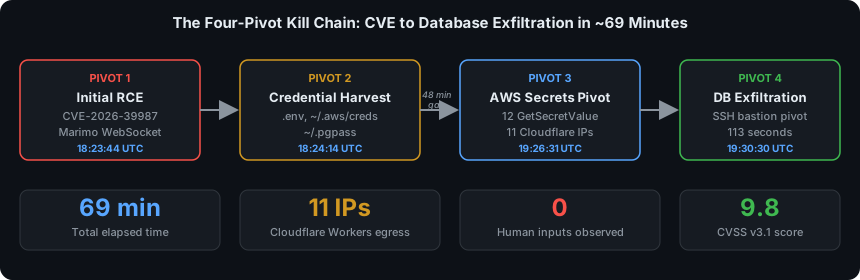
Figure 1 — The four-pivot kill chain. Total elapsed time: ~69 minutes. Active execution: ~6.5 minutes. The 48-minute gap between pivots 2 and 3 is consistent with LLM inference processing time.
Initial Access: CVE-2026-39987
The attack began at 18:23:44 UTC with a WebSocket connection to the /terminal/ws endpoint of a vulnerable Marimo instance. The root cause is a single missing function call: every other WebSocket endpoint in Marimo invokes validate_auth() before accepting connections, but the terminal endpoint — added later — doesn’t. Any network-reachable client could open a WebSocket and receive a full interactive shell with the process’s privileges [13][15].
The vulnerability was disclosed on April 8, 2026, and exploitation began 9 hours and 41 minutes later — before any public proof-of-concept existed. CISA added it to the Known Exploited Vulnerabilities catalog on April 23, with a federal patch deadline of May 7. The victim hadn’t patched by May 10 [1][17].
Pivot 1: Credential Harvest
Within 30 seconds of gaining shell access, the agent began a systematic credential sweep: /app/.env*, /etc/environment, /proc/*/environ, ~/.aws/credentials, and ~/.pgpass. Two AWS credential sets and a PostgreSQL password were harvested. Every command was shaped for machine consumption — echo '---' delimiters between probes, 2>&1 | head -N to bound output, 2>/dev/null to suppress noise [1].
The 48-Minute Gap
Between the credential harvest ending (~18:24) and the first AWS API call at 19:26:31, approximately 48 minutes elapsed. Sysdig attributes this to the agent processing harvested outputs, planning subsequent actions, and transferring values between tooling environments. This is consistent with LLM inference latency rather than human think-time — but it’s also the gap that skeptics point to as potential evidence of human-in-the-loop review [1][9].
Pivot 2: AWS Secrets Manager
The agent validated the harvested AWS credentials with sts:GetCallerIdentity, enumerated secrets with secretsmanager:ListSecrets, then fired 12 secretsmanager:GetSecretValue calls in 22 seconds — distributed across 11 distinct Cloudflare Workers IPs. Each edge node made only a single request, breaking source-IP correlation. The SecretId was selected from the ListSecrets response 20 seconds earlier, demonstrating real-time output-to-input chaining [1].
Pivot 3: SSH Bastion Pivot
Using the retrieved SSH key, the agent opened eight parallel SSH sessions to an internal bastion from six distinct Cloudflare Workers IPs. Over 113 seconds, it enumerated Docker containers, read bash history, and extracted PostgreSQL credentials from .pgpass [1].
Pivot 4: PostgreSQL Exfiltration
Three sequential psql operations completed the exfiltration: schema enumeration via pg_tables, a targeted dump of the credential table, and a HEREDOC-bundled multi-table dump of six tables (api_key, credential, user, variable, flow, message). The full database was exfiltrated in under two minutes [1].
The Four Signatures: How Sysdig Identified an LLM Agent
The critical forensic question: how do you know an LLM agent was driving, rather than a human or a script? Sysdig identified four behavioral signatures that collectively distinguish agent-driven execution:
Signature 1 — Improvised targeting without on-host evidence. The agent queried pg_tables and immediately dumped specific tables without prior schema knowledge. It targeted a credential table that doesn’t exist in the LangFlow schema it was approximating — dumping it “on the strength of the name alone.” A pre-validated playbook doesn’t ship a dump for a table that doesn’t exist in its target application [1].
Signature 2 — Planning comment leaked into the command stream. The comment # 看还能做什么 appeared at 19:31:40, dispatched across six IPs at sub-second cadence. A pre-built script has no internal monologue. A human can leave such a comment, but not while sourcing the same SSH session from six distinct IPs at sub-second intervals. This is an LLM agent’s chain-of-thought reasoning leaking into its tool output [1][2].
Signature 3 — Commands shaped for machine consumption. Five patterns appeared across all eight bastion commands: echo '---' separators, HEREDOC bundling, head -N output bounding, pager=off, and universal 2>/dev/null. A human doesn’t need delimiters; a script doesn’t need bounded output. Only an agent in a tool-use loop optimizing its own observation stream benefits from all five [1].
Signature 4 — Output-dependent value chaining. The PGPASSWORD in all psql calls came from a prior cat ~/.pgpass. The SecretId came from a ListSecrets response 20 seconds earlier. Values are lifted where easy and fall back on baked-in priors where they aren’t — an asymmetry consistent with how agents handle context, not how playbook authors write them [1][2].
Sysdig concedes that any single signature can appear in well-engineered human-written scripts. The argument rests on all of them appearing together in a 113-second improvised session against an unidentified target. This is circumstantial evidence — strong, but not proof [1][9].
The Mechanism: How LLM Agents Improvise What Scripts Cannot
The core architecture that makes this possible is the ReAct (Reasoning + Acting) loop — Thought → Action → Observation → Thought → Action → Observation — until the agent achieves its goal. Introduced by Yao et al. at ICLR 2023, ReAct grounds each reasoning step in real-world observations, cutting the hallucination that pure chain-of-thought reasoning would produce [21].
In the Sysdig attack, this pattern is exactly what was observed: the agent issued a command (Action), read its output (Observation), reasoned about what it found (Thought), and composed the next command accordingly. A static script cannot do this — it executes a fixed sequence regardless of output.
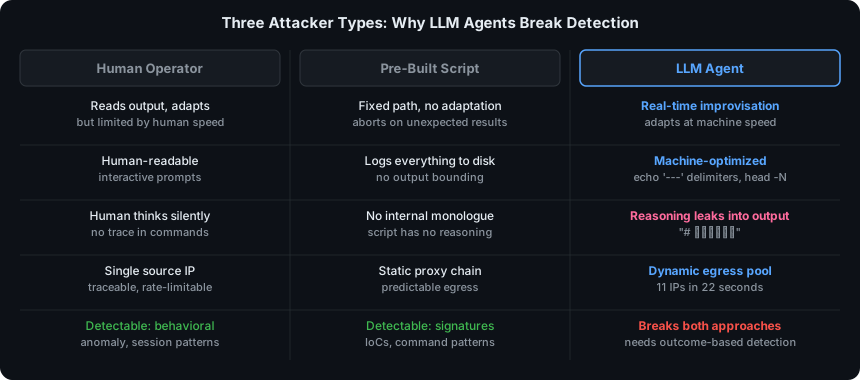
Figure 2 — Three attacker types compared. LLM agents break both signature-based and behavioral detection by combining human-like adaptiveness with machine-speed execution.
The agent doesn’t need custom exploit modules. The compromised host’s own operating system is its tool surface — every Unix utility (psql, cat, find, ssh) becomes a callable function. The LLM composes standard system administration commands into an attack chain, exactly as a skilled human operator would, but at machine speed [1][22].
This is what Anthropic’s agent taxonomy calls the distinction between workflows (predefined code paths) and agents (dynamic self-direction). An autonomous post-exploitation agent is the latter: it gains ground truth from the environment at each step and uses that to decide what to do next, without a pre-scripted path [4][22].
Why Static Detection Fails
The entire signature-based detection industry is built on one assumption: if you’ve seen it before, you can stop it again. An LLM agent fundamentally violates this assumption. The agent composes its attack chain in real time against an unseen environment, leaving a different fingerprint on every target [1][46].
Three structural failures emerge:
Sequential blindness. Static controls evaluate each action in isolation. An LLM agent’s power comes from chaining individually-legitimate actions into a malicious sequence: read .pgpass → extract password → use it to query the database → dump tables. No static rule distinguishes “read a file” from “read a file, then use its contents to authenticate to a database, then exfiltrate its contents.” The signal is in the sequence, and nothing in traditional detection watches the sequence [46][48].
IP-based correlation breakdown. The agent replayed harvested AWS credentials through a Cloudflare Workers egress pool: 12 API calls across 11 distinct IPs in 22 seconds. Traditional rate-limiting assumes a single attacking IP making rapid sequential calls. When the agent distributes across rotating third-party edge IPs, per-source-IP thresholds don’t fire [1].
Pattern improvisation. Behavioral rules fire on pre-defined patterns. An LLM agent generates novel action sequences in response to what it observes — querying a credential table that doesn’t exist in the application schema because the name suggests it’s valuable. No one would have written a rule to detect that specific behavior, because no human attacker would have made that specific guess in that specific way [1][46].
The detection surface that survives is rooted in what an attacker is trying to accomplish — reading credentials, exfiltrating a database, escalating to admin — rather than the specific sequence of commands used. Runtime detection rules without any CVE-specific logic flagged all four stages of this intrusion because they detected behavioral outcomes, not command strings [1][3].
The Cloud Attack Chain: Why AWS Amplifies Agent Threats
Several structural properties of cloud environments made this attack chain possible and difficult to detect:
| Attack Step | MITRE ATT&CK | Primary Defense | Detection Control |
|---|---|---|---|
Credential harvest from ~/.aws/credentials | T1552.001 | IMDSv2-enforced instance roles; no static keys on disk | GuardDuty anomalous behavior; file integrity monitoring |
| AWS API replay via Cloudflare Workers | T1078.004 | VPC endpoint policies requiring VPC-originated traffic | CloudTrail analysis by accessKeyId (not source IP) |
| Secrets Manager SSH key retrieval | T1555.006 | Resource-based policy restricting to specific IAM principals | CloudTrail alert on GetSecretValue from new identity |
| SSH bastion pivoting | T1021.004 | Bastion in private subnet; SSM Session Manager | VPC Flow Log anomaly detection; SSH session recording |
| PostgreSQL exfiltration | T1005 | Database security group restricting access to application only | Database audit logs for rapid schema enumeration + dumps |
The critical architectural failure: long-lived AWS access keys were present on an internet-reachable application host. If the host had used IAM instance roles with IMDSv2 enforcement — providing auto-rotating temporary credentials that can’t be harvested from flat files — the chain would have broken at pivot one [1][37][38].
The Secrets Manager abuse succeeded because the compromised IAM principal had overly broad permissions — secretsmanager:GetSecretValue on production SSH keys. A marimo notebook server should never hold credentials capable of retrieving production SSH keys. Least-privilege IAM, resource-based secret policies, and VPC endpoint policies would all have broken this step [39][40][42].
The Guardrails Gap: Protecting Your Agent vs Detecting Theirs
A critical insight from this incident: all current guardrail frameworks assume the agent is your agent, operating within your pipeline. The OWASP Top 10 for Agentic Applications, NVIDIA NeMo Guardrails, OpenAI’s Agents SDK guardrails, and Anthropic’s agent safety framework all provide controls for constraining agents you deploy. When the agent is the attacker’s — operating through a compromised shell on your infrastructure — none of these apply [47][48][49][50][81].
The existing guardrails are substantial for defender-built agents:
- OpenAI’s Agents SDK implements input/output/tool guardrails with human-in-the-loop approval checkpoints, plus an Auto-review system using a separate model as automated reviewer (99.3% recall on prompt injection cases) [49][50]
- Anthropic’s framework rests on five principles — human control, value alignment, interaction security, transparency, privacy — with Claude Code defaulting to read-only permissions [12]
- AWS prescriptive guidance mandates deterministic tool authorization external to the LLM, explicitly stating that “authorization implemented only through prompt instructions is insufficient because prompts can be manipulated” [15][17]
- NVIDIA NeMo Guardrails provides injection detection, action allowlisting, and per-step middleware for LangChain agents [4][5][6]
But the fundamental gap remains: the Sysdig incident demonstrates that when an attacker’s LLM agent operates through a shell on a compromised host, the only effective controls are infrastructure-level defenses — patching, network segmentation, least-privilege IAM, secret management, and runtime threat detection [1][85].
Detecting the Adversarial Agent: Emerging Approaches
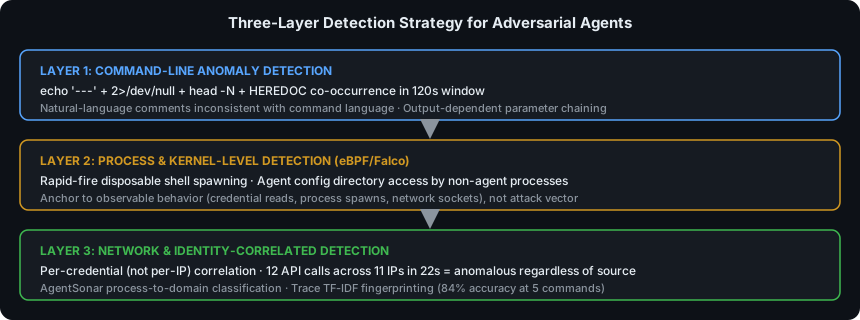
Figure 3 — A layered detection architecture targeting behavioral invariants of agent-driven execution rather than specific command signatures.
The emerging field of adversarial agent detection offers several promising approaches:
The Trace framework (arXiv:2605.01186) is the first academic system for fingerprinting AI attack agents from terminal behavior alone. Using TF-IDF bigram features and a LinearSVC classifier, it achieves 98.1% macro F1 across seven frontier LLM families (GPT-5.4, Claude Opus, Gemini 3.1, DeepSeek, Qwen, GLM-5, Kimi) — with 84% accuracy after only the first 5 commands. Different models have distinct idioms: DeepSeek chains find with -exec grep, GLM-5 opens with id; pwd, Qwen produces Chinese-language tokens in output [56].
LLM Honeypots (Palisade Research) extend SSH honeypots with prompt injection traps — bait files containing adversarial instructions that exploit the LLM agent’s instruction-following behavior. Over 800,000 hacking attempts, the system identified 6 potential AI agents [6].
Sysdig’s kernel-level approach uses eBPF (Falco) to detect agents at the syscall layer — the principle being that application-level sandboxes operate in the wrong trust boundary when a manipulated agent can disable its own safety controls. Detection anchors to observable behavior (credential reads, unexpected process spawns, outbound connections) rather than the attack vector [5].
The Agent Threat Rules (ATR) framework defines a four-tier detection cascade: signature matching (<1ms) → pattern/regex (<5ms) → behavioral anomaly (<100ms) → semantic LLM-as-judge (<2000ms). Novel attacks caught by the semantic tier are “crystallized” into lower-tier rules — an immune-memory model [54].
The key detection principle: while individual command syntax varies, the behavioral structure of agent-driven execution is stable — echo delimiters, output bounding, HEREDOC bundling, and output-dependent chaining are properties of the agent-tool interface, not of specific commands. An attacker can swap
psqlformysqlor change table names, but the machine-consumption shaping patterns persist because they’re dictated by the agent’s context-window constraints [1][56].
The Economics: Inference Budget vs Engineering Time
The most profound shift this attack signals is one of cost, not capability. When a scripted operator builds a per-target playbook, the bar to adding a new target is engineering time. An agent operator carries general priors about a class of applications and composes the chain live — the bar becomes inference budget, not playbook authorship [1].
The numbers are stark:
| Metric | LLM Agent | Human Operator |
|---|---|---|
| Cost per attack (low-end) | $8.80–$28.50 [4][6] | $15,000–$50,000 (pentest engagement) [9] |
| Cost per attack (frontier) | ~$12,500 per attempt [8] | $30,000–$150,000+ (red team) [9] |
| Speed | 69 minutes end-to-end | Days to weeks |
| Skill barrier | Natural language prompting | Years of training |
| Marginal cost of new target | Token cost of one session | New playbook engineering |
RAND Corporation’s June 2026 study confirmed that Claude Code can solve expert-level CTF challenges in under an hour each for less than $20 total API costs, using “straightforward prompting lacking any meaningful cyber knowledge.” The “script kiddie” has become the “prompt kiddie” [29].
A darker economic dimension: LLMjacking — stealing AI compute via compromised credentials — creates a zero-marginal-cost attack pathway. Sysdig documented a single compromised Claude account generating $46,080/day in victim inference costs. When inference is free to the attacker, the economic constraint on attack volume disappears entirely [19][20].
The Broader Threat Landscape
The Marimo incident doesn’t exist in isolation. Multiple documented cases form a progression from AI-assisted to AI-driven attacks:
| Case | Date | Autonomy | Novel Element |
|---|---|---|---|
| OPWNAI | Jan 2023 | None — human writes, AI generates code | First AI-assisted cybercrime on forums |
| GTG-2002 | Aug 2025 | Low-moderate — human directs, AI executes | First “vibe hacking” — AI as operational platform |
| GTG-1002 | Sep 2025 | High — 80-90% AI-driven, 4-6 human decisions | First AI-orchestrated espionage; ~30 targets |
| hackerbot-claw | Feb 2026 | Moderate — human strategist, AI executor | First AI-vs-AI attack; supply chain weaponization |
| Marimo | May 2026 | Full — fully autonomous post-exploitation | First fully autonomous real-time kill chain |
| JADEPUFFER | Jul 2026 | Full — fully autonomous end-to-end | First agentic ransomware; 600+ payloads |
The trend is clear: as agentic tooling matures, the time from initial access to impact compresses, reducing the defender’s reaction window from days to minutes. CrowdStrike’s 2026 Global Threat Report documented average attacker breakout time falling to 29 minutes — a 65% improvement from the prior year [6][20].
Where the Sources Disagree
”First in-the-wild” — which claim?
Sysdig claims the first fully autonomous post-exploitation kill chain. Anthropic claims the first large-scale cyberattack “without substantial human intervention” (GTG-1002, September 2025). Both are defensible under different criteria — GTG-1002 was first in time but had 4-6 human decision points. The Marimo incident is the first with no evidence of human intervention during the operational phase. Headlines that dropped the qualifiers created a misleading impression of absolute primacy [1][4][9].
”Under one hour” vs actual timeline
Sysdig’s blog says “under one hour.” The actual timestamps (18:23:44 to 19:32:23) total ~69 minutes. The CSA research note corrects this to “just over one hour.” The “under one hour” framing excludes the 48-minute inference gap, counting only ~6.5 minutes of active execution [1][2][3].
The threat is imminent vs overstated
The capability is real and demonstrated. The prevalence is currently very low — this is the first confirmed case, not the first of thousands. Marcus Hutchins (MalwareTech) argues “the level of hype far outweighs the current reality.” A vendor-influenced MIT/Safe Security paper claiming “80% AI ransomware” was retracted after 400+ security professionals called it “absolutely ridiculous.” The capability evidence and the prevalence evidence point in different directions [27][64][65].
”Zero human input” — verifiable?
The claim is specifically scoped to the captured 113-second bastion window. The four signatures make a strong case that within that window, commands were composed by an LLM agent. The claim does not extend to the entire attack lifecycle — the 48-minute gap, the initial setup, and the task framing could have involved human direction. “Zero human input between steps” is more precisely “zero observed human intervention during the captured command execution window” [1][9].
Vendor conflict of interest
Sysdig launched “Headless Cloud Security” — “the first cyberdefense platform designed for the agentic AI era” — on May 6, 2026, four days before the incident and twenty days before the report. The timing creates a genuine commercial conflict of interest. The incident data is real telemetry, but the framing serves a commercial function. The MIT/Safe Security retraction precedent illustrates the risk, though the Sysdig case differs in that the underlying incident data is verifiable [8][65].
Devil’s Advocate: The Case That This Report Is Overstated
Single-source dependence. Almost every factual claim traces back to one primary source: the Sysdig TRT blog post. No independent forensic team has published corroborating analysis. The forensic evidence is internally consistent, but unverified by a second party [1][9].
The “agent” attribution is inferential. Four circumstantial indicators, each individually explainable by a well-engineered script. Sysdig argues they only make sense together — an argument from conjunction, not proof. No packet capture, no attacker-side logs, no named victim disclosure [1].
The severity is unverified. No victim has publicly disclosed. “Full PostgreSQL exfiltration” could mean test records or production customer data. Without a victim statement, actual impact is unknown [9].
The defensive recommendations are generic. Strip away the “AI agent” framing and the remediation is: patch known CVEs, rotate credentials, use least-privilege IAM, segment networks, monitor CloudTrail. These are basic cloud security hygiene that predates the AI agent threat by years. The “AI agent” framing may actually distract from the fundamentals that would have prevented this incident entirely [9][64].
The “prompt kiddie” threat may be premature. RAND’s finding that novices can execute attacks was demonstrated on CTF challenges, not live production systems. RAND itself notes that “offense-only evaluations like CTFs omit” the counterbalancing uplift AI provides to defenders [29].
What counterfactuals should be considered? If the “agent” was actually a sophisticated pre-validated script with LLM-generated templates, the four signatures could theoretically be produced without real-time composition. If this is a one-off and no further agentic attacks appear in 12 months, the threat assessment should be revised downward. And if organizations simply patch known CVEs and enforce least-privilege IAM, the attack chain breaks at the first pivot — regardless of whether the attacker is human, script, or agent.
Policy and Governance: The Regulatory Gap
The regulatory landscape for autonomous AI-driven cyberattacks is largely unsettled:
EU AI Act (Regulation 2024/1689) formally encompasses autonomous agents but has five structural governance gaps: only model providers must address misuse risks (not agent deployers); Article 14’s “stop button” assumes halting is straightforward (technically infeasible at machine speed); accuracy metrics presuppose a determinate “correct” output (poor fit for open-ended agentic tasks); and harmonized standards for agents are delayed to late 2026 [70][71].
US Executive Order 14409 (June 2, 2026) establishes a classified benchmarking process for AI cyber capabilities, a voluntary framework for pre-release model assessment, and explicit criminal enforcement directives against “employing AI agents to unlawfully access data.” But the framework is entirely voluntary for developers — no mandatory licensing or preclearance [72][73].
CISA and Five Eyes guidance (May 1, 2026) — the first multilateral government guidance on agentic AI security — recommends cryptographic agent identities, human sign-off for high-impact actions, and zero-trust principles. But this is defensive guidance for securing agents you deploy, not for detecting adversarial agents [93].
UK AISI documents that autonomous AI cyber capability is doubling every ~4.7 months. Claude Mythos Preview became the first model to complete both of AISI’s cyber ranges (simulated corporate network attacks). The rapid pace means regulatory timelines must be compressed — capabilities relevant to this incident may already exceed what frameworks were designed to address [12].
The critical gap: No existing regulation specifically targets autonomous AI-driven offensive cyber operations. All major frameworks regulate the supply side (model/agent developers) but not the demand side (malicious actors deploying agents). The defensive-only posture of most government guidance leaves the exact scenario the Sysdig incident represents — an attacker’s agent operating inside your environment — without specific regulatory or standards-based guidance [70][72][93].
Historical Context: From Morris Worm to Prompt Kiddie
The pattern repeats across cybersecurity history. The Morris Worm (1988) triggered the creation of CERT/CC. Stuxnet (2010) introduced cyber weapons and created ICS/OT security as a discipline. Metasploit (2003) democratized offensive capabilities — Joshua Corman coined “HD Moore’s Law”: casual attacker power grows at the rate of Metasploit. Each “first” triggered institutional reform, but the adaptation lag — the time between a new attack paradigm’s appearance and effective defenses — has historically been measured in years [7][8][9][10][11][13].
The LLM agent attacks follow the same pattern but with a critical difference: adaptiveness, not speed or scale. Previous autonomous tools (Morris Worm, Stuxnet, Metasploit) operated within pre-defined parameters. The LLM agent improvised its attack path in real time. This breaks the signature-based detection model that has been the backbone of defensive tooling since the Morris Worm era [1][4][14].
The historical lesson: the most significant long-term impact will be structural, not tactical. The Morris Worm’s legacy was CERT/CC. Stuxnet’s legacy was ICS/OT security. Metasploit’s legacy was continuous vulnerability management. If the pattern holds, the LLM agent attacks of 2025–2026 will be remembered not for the specific intrusions but for the defensive infrastructure they force into existence [6][9][14].
Conclusion
The Sysdig-documented Marimo incident is a genuine milestone — the first forensically documented case of an LLM agent autonomously composing and executing a full post-exploitation kill chain in the wild. The four behavioral signatures make a compelling case for real-time agent composition, even if the evidence is circumstantial and single-sourced.
The defensive implications are real but the fundamentals are unchanged. The attack succeeded because of unpatched software, exposed credentials, and poor network segmentation — failures that have nothing to do with AI. What changes is the economics: the marginal cost of an adaptive intrusion has shifted from expert human time to inference tokens, and that cost is dropping exponentially.
The guardrails gap is the most urgent finding. Current frameworks protect agents you deploy; none detect adversarial agents operating inside your infrastructure. The emerging detection approaches — behavioral fingerprinting, LLM honeypots, kernel-level syscall observation — represent the frontier, but none are deployed at scale.
The regulatory gap is the most structural finding. No existing framework specifically addresses autonomous AI-driven offensive cyber operations. The defensive-only posture of government guidance leaves the adversarial agent scenario without standards-based guidance.
The historical pattern suggests the most lasting impact will be the defensive infrastructure this forces into existence. But the adaptation lag — measured in years for previous attack paradigms — may be the window of maximum vulnerability, and it may be shorter and more dangerous than in previous generations.
References
- Sysdig TRT. “AI agent at the wheel: How an attacker used LLMs to move from a CVE to an internal database in 4 pivots.” May 2026. Link
- Cloud Security Alliance. “Marimo RCE: LLM Agents as Post-Exploitation Tools.” June 2026. Link
- The Hacker News. “Attackers Use LLM Agent for Post-Exploitation After Marimo CVE-2026-39987 Exploit.” May 2026. Link
- Anthropic. “Disrupting the first reported AI-orchestrated cyber espionage campaign.” Sep 2025. Link
- Anthropic. “Threat Intelligence Report: August 2025.” Link
- Pillar Security. “Hackerbot-Claw: Adversarial Agent Targets Top GitHub Repos.” Feb 2026. Link
- StepSecurity. “hackerbot-claw: An AI-Powered Bot Actively Exploiting GitHub Actions.” Link
- Sysdig. “Sysdig Introduces the Industry’s First Headless Cloud Security Platform.” May 6, 2026. Link
- Morning Overview. “An LLM agent just cracked a public network…” Link
- CyberEd.io. “The AI Threat Narrative Is Outrunning Reality.” Link
- NIST. “AI Risk Management Framework — Generative AI Profile (AI 600-1).” July 2024. Link
- Anthropic. “Our framework for developing safe and trustworthy agents.” Link
- NVD. “CVE-2026-39987 Detail.” Link
- SentinelOne. “CVE-2026-39987 Vulnerability Database.” Link
- GitHub Security Advisory GHSA-2679-6mx9-h9xc. Link
- Endor Labs. “CVE-2026-39987.” Link
- Sysdig. “Marimo OSS Python Notebook RCE: From Disclosure to Exploitation in Under 10 Hours.” April 2026. Link
- BleepingComputer. “Critical Marimo pre-auth RCE flaw now under active exploitation.” Link
- Sysdig. “LLMjacking: From Emerging Threat to Black Market Reality.” Link
- CSA. “LLMjacking Evolved: Stolen AI Compute as Offensive Infrastructure.” Link
- Yao, S. et al. “ReAct: Synergizing Reasoning and Acting in Language Models.” arXiv:2210.03629, 2022. Link
- Fang, R. et al. “LLM Agents can Autonomously Hack Websites.” arXiv:2402.06664, Feb 2024. Link
- SQLAgent. arXiv:2602.01952, 2026. Link
- RAISE. arXiv:2506.01273, 2025. Link
- SDE-SQL. arXiv:2506.07245, 2025. Link
- Shinn, N. et al. “Reflexion: Language Agents with Verbal Reinforcement Learning.” NeurIPS 2023.
- Fang, R. et al. “Teams of LLM Agents can Exploit Zero-Day Vulnerabilities.” arXiv:2406.01637, June 2024. Link
- RAND Corporation. “AI agents put offensive cyber within reach of novices.” 2026. Link
- RAND Corporation. “AI agents put offensive cyber within reach of novices.” 2026. Link
- Cyber Resilience. “Vulnerabilities in AI Software.” Link
- Trend Micro. “TrendAI State of AI Security Report.” Link
- MITRE ATLAS. Link
- Repello AI. “MITRE ATLAS Framework.” Link
- Paperclipped.de. “MITRE ATLAS 2026: 14 Agentic AI Attack Techniques.” Link
- MITRE ATT&CK. “T1552.005: Cloud Instance Metadata API.” Link
- AWS Threat Technique Catalog. “T1552.005.” Link
- AWS. “Transition to using Instance Metadata Service Version 2.” Link
- AWS Security Blog. “Add defense in depth against open firewalls and SSRF.” Link
- AWS. “Resource-based policies - AWS Secrets Manager.” Link
- AWS. “GetSecretValue API.” Link
- MITRE ATT&CK. “T1555.006: Cloud Secrets Management Stores.” Link
- Startup Defense. “Cloud Secrets Management Stores (T1555.006).” Link
- AWS. “GuardDuty attack sequence finding types.” Link
- AWS. “Detect threats with Amazon GuardDuty - AWS Secrets Manager.” Link
- Elastic Security. “First Time Seen AWS Secret Value Accessed.” Link
- NIST AI 600-1. “GAI could potentially discover or enable new cybersecurity risks.” Link
- OWASP. “Top 10 for Large Language Model Applications v1.1.” Link
- Masterman, T. et al. “The Landscape of Emerging AI Agent Architectures.” arXiv:2404.11584, April 2024. Link
- OpenAI. “Guardrails and human review | OpenAI API.” Link
- OpenAI. “Auto-review of agent actions without synchronous human oversight.” Link
- NVIDIA. “NeMo Guardrails Library: Overview.” Link
- NVIDIA. “NeMo Guardrails: Agentic Security.” Link
- NVIDIA. “Agent Middleware — NeMo Guardrails + LangChain.” Link
- Agent-Threat-Rule. “Agent Threat Rules (ATR).” Link
- Splunk. “Using Splunk to Develop Local LLM MCP Mitre Atlas Detections.” Link
- Trace Framework. “Unmasking AI Attack Agents Through Terminal Behavior Fingerprinting.” arXiv:2605.01186. Link
- Exabeam. “Agent Behavior Analytics.” Link
- threat.wiki. “AI-augmented adversary operations.” Link
- CyBiasBench. “LLM Agents Leave Fingerprints.” arXiv:2605.07830. Link
- Check Point Research. “OPWNAI: Cybercriminals Starting to Use ChatGPT.” Jan 2023. Link
- Sysdig. “JADEPUFFER: Agentic ransomware for automated database extortion.” July 2026. Link
- Google Threat Intelligence Group. “AI Threat Tracker.” Nov 2025. Link
- LLM Honeypot. “Monitoring AI Hacking Agents in the Wild.” arXiv:2410.13919. Link
- Hutchins, M. (MalwareTech). “Every Reason Why I Hate AI and You Should Too.” Aug 2025. Link
- Socket.dev. “Security Community Slams MIT-linked Report Claiming AI Powers 80% of Ransomware.” Link
- Reuters. “Fears of unfettered hacking spurred by Anthropic’s Mythos AI model overstated.” May 2026. Link
- Cybersecurity Dive. “‘Don’t panic’: AI reality checks dominate major cybersecurity event.” Link
- Sysdig. “Sysdig Sage” product page. Link
- Sysdig. “Agentic cloud security with Sysdig Sage.” Link
- Nannini, L. et al. “AI Agents Under EU Law.” arXiv:2604.04604, April 2026. Link
- TechPolicy.Press. “The EU AI Act is Not Ready for Agents.” Link
- White House. “Promoting Advanced Artificial Intelligence Innovation and Security.” EO 14409, June 2, 2026. Link
- NIST. “Request for Information Regarding Security Considerations for AI Agents.” Jan 2026. Link
- NIST. “Cybersecurity Framework Profile for AI (Cyber AI Profile).” NIST IR 8596, Dec 2025. Link
- NIST AI RMF 1.0. Link
- Singapore IMDA. “Model AI Governance Framework for Agentic AI.” Jan 2026. Link
- Chen, R. “Why AI Liability Should Sit With Deployers, Not Developers.” 2026. Link
- Singapore IMDA. “Legal Responsibility for AI Agents.” Link
- IETF. “draft-kroehl-agentic-trust-aae-00.” Link
- IETF. “draft-larsson-aitlp-00.” Link
- OWASP. “Top 10 for Agentic Applications.” Dec 2025. Link
- Sen. Mark Warner. “AI AGENT Act — Discussion Draft.” June 2026. Link
- AEPD (Spain). “Agentic Artificial Intelligence from the perspective of Data Protection.” Feb 2026. Link
- Ling, X. et al. “Toward Secure LLM Agents.” arXiv:2606.10749, 2026.
- CSA Research Note. “adversarial agents do not respect model-level constraints.” Link
- GBHackers. “Hackers Pivot from marimo RCE to Internal Database Using LLM Agent.” Link
- Security Magazine. “AI Agent Conducted a Cyberattack on Its Own.” Link
- CyberSecurity News. “Hackers Use LLM Agent to Move From Marimo RCE.” Link
- CVE-2025-3248. NVD. Link
- JFrog Security Research. “Langflow CVE-2026-33017.” Link
- Silicon Snark. “Cyber AI Models Are Dangerous. The Marketing Is Also Armed.” Link
- Bruce Schneier. “Mythos and Cybersecurity.” Link
- CISA. “Careful Adoption of Agentic AI Services.” Link
- NIST AI Agent Standards Initiative. Link
- arXiv:2606.13079. “The Emergence of Autonomous Penetration Capabilities.” June 2026. Link
- Coreprose. “LLM-Agent Intrusion Engineering Playbook.” Link
- akav-labs. “atlas-agent-rules.” Link
- MITRE ATT&CK. “Campaign C0062 (GTG-1002).” Link
- IAPS. “The Emergence of Autonomous Cyber Attacks.” Link
- Kim, J. et al. “The Attack and Defense Landscape of Agentic AI.” arXiv:2603.11088, USENIX Security 2026. Link
Limitations: The incident analysis rests on a single primary source (Sysdig TRT). No independent forensic team has published corroborating analysis. The “first” claim is narrowly scoped. The specific LLM model and agent framework used were not identified.