Planner-Executor vs. Single-Loop Agents: When Does Task Decomposition Actually Help?
The debate between planner-executor (explicit task decomposition followed by sequential execution) and single-loop (ReAct-style interleaved reasoning and acting) agent architectures is one of the most consequential design decisions in building LLM-based autonomous agents. The answer that emerges from a comprehensive survey of benchmarks, papers, and production systems is not a simple “one is better”—it is a conditional, difficulty-dependent, model-dependent verdict.
There exists a complexity crossover point. For tasks below roughly 5–7 steps, single-loop ReAct agents are competitive or superior: they avoid planning overhead, adapt naturally to unexpected observations, and never execute stale plans. For harder tasks, structured scaffolds—including planner-executor and multi-agent architectures—provide statistically significant advantages. The most rigorous controlled study finds scaffold choice alone shifts measured accuracy by up to 28 percentage points within a single model [1].
But decomposition introduces its own failure modes that can be as severe as the problems it solves. Error propagation compounds across sub-tasks (approximately p^t under independence), a self-conditioning effect makes models more error-prone when their context contains prior errors, and extreme decomposition creates a no-recovery bottleneck where hard-step errors become irrecoverable.
Meanwhile, the industry is converging on simpler architectures enabled by stronger models. Mini-SWE-agent—a 100-line single-loop agent using only bash—achieves >74% on SWE-bench Verified, matching or exceeding complex multi-agent systems [6].
This report synthesizes evidence from 50+ papers, benchmarks, and production systems to answer: when does task decomposition actually help?
The two architectures
Single-loop: The ReAct pattern
The ReAct pattern, introduced by Yao et al. (2022), interleaves reasoning traces (“thoughts”) and actions (tool calls) in a single continuous loop [14]. At each step, the agent generates a thought (reasoning about the current state), takes an action (a tool call), and receives an observation (the tool’s return value, appended to context). The loop terminates when the model emits a terminal action.
The key mechanism is re-conditioning: each next thought conditions on a real observation rather than the model’s own generated prior thought. Chain-of-thought compounds errors across steps because every step conditions on the previous generation; ReAct breaks the chain by re-grounding on tool output.
The original paper demonstrated this across four benchmarks: HotpotQA (27.4 EM with 6% hallucination vs. 56% for CoT), ALFWorld (71% success rate, +34% over the best Act-only baseline), and WebShop (40% success, +10% over previous best) [14].
Planner-executor: The decomposition pattern
The planner-executor pattern separates the agent into phases: a planner LLM decomposes the goal into an ordered sequence of sub-tasks, an executor carries out each sub-task, and a replanner revisits the plan after each step or batch. The pattern traces to Hierarchical Task Networks (HTNs) from classical AI planning, where compound tasks are recursively decomposed into primitive tasks subject to ordering constraints [22].
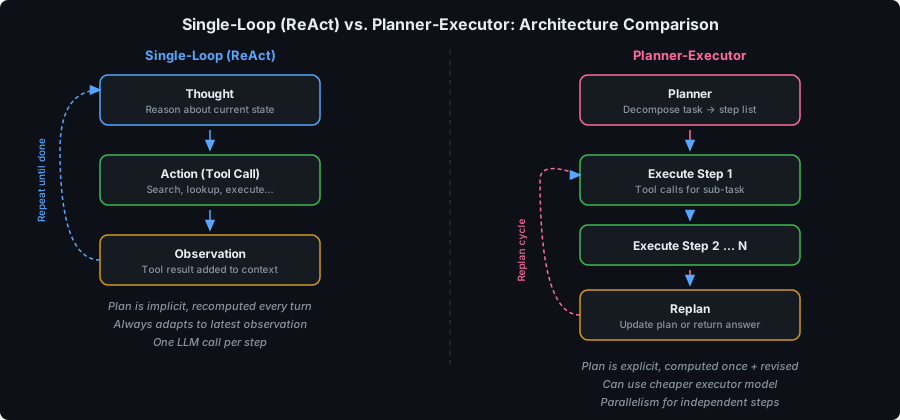
Figure 1 — Side-by-side comparison of the single-loop (ReAct) and planner-executor architectures. In ReAct, the plan is implicit and recomputed every turn. In planner-executor, the plan is explicit, computed once, and revised through replanning cycles.
The fundamental difference
Everything follows from one choice: where the plan lives. In ReAct, the plan is implicit and recomputed every turn. In planner-executor, the plan is explicit and computed once (or per replanning cycle). This determines the trade-offs: ReAct is adaptive but pays a full model round-trip per step; planner-executor is inspectable and can use cheaper executor models but is brittle to execution errors and plan staleness.
The math: error propagation
The p^t problem
If a model has per-step accuracy p, the probability of completing a task of t steps without error is approximately p^t under independence assumptions [2]:
- At p = 0.99, a 69-step task succeeds ~50% of the time
- At p = 0.95, a 14-step task succeeds ~50% of the time
- At p = 0.90, a 7-step task succeeds ~48% of the time
The horizon length at which a model achieves success rate s is approximately ln(s)/ln(p), growing hyperbolically as p approaches 1. Marginal gains in step accuracy yield disproportionate gains in task length—the “illusion of diminishing returns” [2].
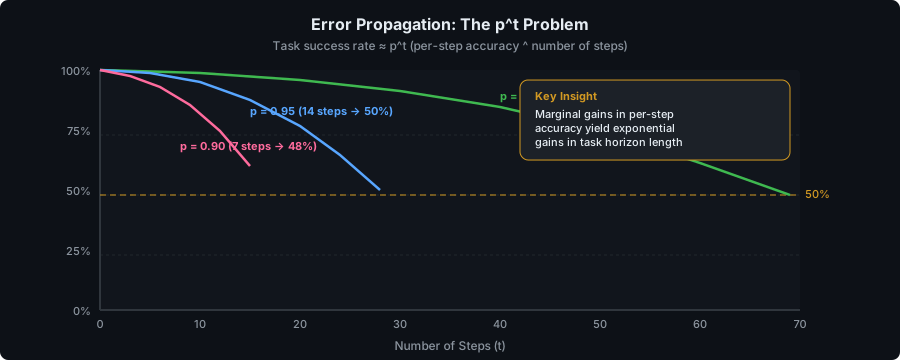
Figure 2 — The compounding error problem. Even high per-step accuracy (99%) yields only ~50% task success over 69 steps. Small improvements in per-step accuracy translate to exponential improvements in achievable task horizon length.
Self-conditioning: errors beget errors
The independence assumption is violated in practice. Sinha et al. (2025) identify a self-conditioning effect: models become more likely to make mistakes when their context contains errors from prior turns [2]. Through controlled error-injection experiments:
- As the rate of injected errors increases, accuracy at turn 100 consistently degrades further, beyond what context length alone explains.
- Unlike long-context degradation, scaling model size does not mitigate self-conditioning—even frontier 200B+ parameter models remain susceptible.
- Self-conditioning accounts for approximately 20% of GAIA failures, 48% of ALFWorld failures, and 33% of WebShop failures.
Thinking models fix self-conditioning. Qwen3 models with RL-trained thinking capabilities no longer self-condition—accuracy at turn 100 remains stable regardless of error rate in prior turns [2]. This is a critical finding: reasoning models partially substitute for explicit decomposition by providing internal error correction.
The compositionality gap
Press et al. (2023) introduce the compositionality gap: the discrepancy between the success probability of a composed task and the product of success probabilities of its subtasks in isolation [27]. Critically, this gap does not diminish with model scaling—suggesting that reliable long-horizon execution does not emerge naturally through scaling alone. This is a key motivation for structural decomposition: it addresses the gap that scaling cannot close.
Benchmark evidence
GAIA: The controlled scaffold study
GAIA (Mialon et al., 2023) is a benchmark of 466 questions requiring multi-step reasoning, tool-use, and web browsing, stratified into three difficulty levels [1]. The original paper reveals an uncomfortable truth: AutoGPT (a planner-executor agent) scored only 0.4% at Level 2—worse than GPT-4 without plugins [1].
The most directly relevant evidence is Starace (2026), a pre-registered controlled comparison of three scaffolds across five frontier models [30]:
- S1: ReAct — Standard single-agent loop
- S2: Planner-Actor-Rater (PAR) — Three-role multi-agent
- S3: Planner-then-Executor — Explicit planning step then execution
Key results:
- Scaffold choice alone moves accuracy by up to 28 percentage points within a single model (Opus, L2).
- PAR outperforms ReAct at L2 within the Anthropic family: Haiku +19.3pp, Sonnet +22.1pp, Opus +27.9pp (CIs above zero). For Gemini (+5.8pp) and GPT-5 (+1.6pp), CIs span zero—not significant. The conditioning variable is model family, not capability tier.
- At L1, no model shows PAR advantage—ReAct remains competitive.
- Planner-then-Executor on file-reading tasks: falsified across all models.
- Structured scaffolds recover from failure more often: 0.57 (PAR) vs. 0.38 (ReAct) at L2.
SWE-bench: Interface over architecture
SWE-agent achieved 12.5% on SWE-bench with a custom Agent-Computer Interface—fundamentally a single-loop agent with well-designed tools [33]. The most striking development: mini-SWE-agent—a ~100-line single-loop agent using only bash—achieves >74% on SWE-bench Verified [6]. The team states: “As LMs have become more capable, a lot of this [special tooling] is not needed.”
Multi-file vs. single-file reveals a sharp complexity gradient: top systems resolve 71.56% of single-file but only 28.17% of multi-file instances [35].
The cross-benchmark pattern
Across all benchmarks, a consistent pattern: the advantage of structured architectures increases with task difficulty.
When decomposition helps
The complexity crossover
Shojaee et al. (2025, Apple) provide the clearest evidence using controlled puzzle environments [3]. They identify three regimes:
- Low complexity: Non-thinking LLMs outperform reasoning models. Thinking overhead provides no benefit.
- Medium complexity: Reasoning models demonstrate clear advantage. The gap widens.
- High complexity: Both model types experience complete accuracy collapse to near-zero. Reasoning models delay collapse but don’t prevent it. Counterintuitively, models reduce reasoning effort near collapse.
Providing the explicit solving algorithm does not help—collapse occurs at the same points. The limitation is not strategy-finding but consistent logical verification and step execution [3].
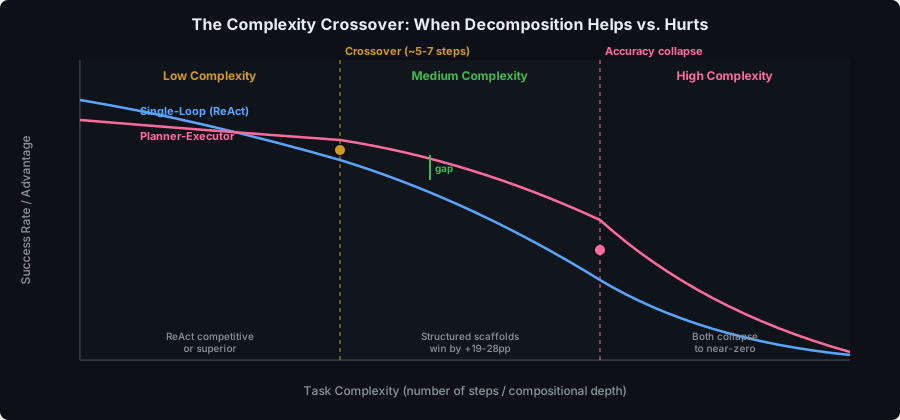
Figure 3 — The three complexity regimes. Below the crossover (~5-7 steps), single-loop ReAct is competitive or superior. Above it, structured scaffolds provide +19 to +28pp gains. At high complexity, both architectures collapse to near-zero accuracy.
Recovery and parallelism
Structured scaffolds recover from mid-trajectory errors more often (0.57 vs. 0.38 recovery rate at GAIA L2) [30]. LLMCompiler’s DAG-based planning enables parallel execution with up to 3.7× latency speedup [20]. The planner-executor pattern enables using a large model for planning and a cheaper model for execution—cost savings up to 6.7× [20].
ADaPT (Prasad et al., NAACL 2024) introduces as-needed decomposition: attempt execution first, decompose only on failure [38]. The key insight: decomposition should be reactive, not proactive.
When decomposition hurts
The Goldilocks problem
Paglieri et al. (2025) formalize the cost of planning as C_plan = C_tokens + C_latency + C_noise [4]. Their finding: always planning degrades performance. Performance peaks at intermediate planning frequencies. The always-plan agent exhibited the highest rate of backtracking.
Plan staleness
Plans generated under incomplete information become stale. Failure modes include commitment bias, replanning loops (plan → fail → near-identical plan → repeat), and drift cascade (each replan loses context; by plan five, the agent solves a different problem) [42][43].
The no-recovery bottleneck
LEAD (ICML 2025) identifies a paradox: extreme decomposition—where every step executes in isolation—creates a no-recovery bottleneck [5]. Errors concentrate on a few “hard” steps. Because these errors are consistent (not random), majority voting fails. The solution is the Goldilocks zone: enough isolation for stability, enough context for correction.
Overthinking
Chen et al. (2024) document “overthinking of o1-like LLMs”—unnecessarily long reasoning traces for simple problems [44]. “To CoT or not to CoT?” found CoT helps mainly on math and symbolic reasoning [46].
Where the sources disagree
Do reasoning models eliminate the need for decomposition? Partially—thinking models fix self-conditioning and extend execution to thousands of steps [2]. But even the strongest reasoning models collapse beyond complexity thresholds [3], and the compositionality gap doesn’t diminish with scaling [27]. Reasoning models shift the threshold upward but don’t eliminate it.
Does the planner-executor advantage generalize across models? Only for Anthropic models, according to the GAIA scaffold study [30]. Gemini and GPT-5 show no significant multi-agent advantage. No other study controls for this interaction.
Is in-context prompting making orchestration obsolete? For procedural tasks, yes—Dennis et al. (2026) show in-context prompting outperforms external orchestration [49]. For open-ended tasks, no—structured scaffolds provide significant advantages [30].
Design heuristics
The industry consensus: start simple
“When building applications with LLMs, we recommend finding the simplest solution possible, and only increasing complexity when needed.” — Anthropic [10]
“At its core, an agent is just a model calling tools in a loop until a task is complete.” — LangChain [12]
“What if our agent was 100x simpler, and still worked nearly as well?” — mini-SWE-agent [6]
Architecture selection matrix
| Factor | Favors Planner-Executor | Favors Single-Loop |
|---|---|---|
| Task complexity | >5–7 steps, multi-file | <5–7 steps, single-tool |
| Model type | Mid-tier, non-reasoning | Frontier, reasoning models |
| Task predictability | Fixed, decomposable | Open-ended, unpredictable |
| Tool count | >20, need selection | <10 |
| Task horizon | Multi-session, visible plan | Single session, inline reasoning |
| Cost optimization | Cheaper executor model | Fewer total LLM calls |
| Model family | Anthropic benefits most | All competitive at L1 |
Key heuristics
- Start simple. Begin with single-loop; add complexity only when evaluation shows it’s needed.
- Invest in tool design over architecture. The Agent-Computer Interface matters more than topology.
- Reasoning models reduce the need for external planning. o1/o3 and Claude extended thinking internalize planning.
- Use middleware, not new architectures. Planning, tool selection, context management as composable layers.
- For long-horizon tasks, improve the harness, not the architecture. Progress files, feature lists, git checkpoints.
- Multi-agent patterns are for context management, not decomposition. Surviving patterns isolate context.
- For hard tasks (>5–7 steps), structured scaffolds provide statistically significant advantages. +19 to +28pp at GAIA L2.
- Decomposition granularity matters. Too coarse fails; too fine drowns in overhead.
Common misconceptions
“Planner-executor agents are more intelligent.” No—they are more structured. The intelligence comes from the model. Mini-SWE-agent outperforms complex multi-agent systems because the model carries the reasoning load.
“Single-loop agents can’t handle complex tasks.” They can, increasingly, with reasoning models. GPT-5 with thinking achieves 2,176 sequential execution steps [2].
“More decomposition is always better.” The opposite is true. Extreme decomposition creates a no-recovery bottleneck [5]. Always planning degrades performance [4].
“AutoGPT proved autonomous agents work.” AutoGPT scored 0.4% on GAIA Level 2 [1].
Devil’s advocate
This report may overstate the case for single-loop architectures. The benchmarks may be too easy—GAIA Level 2 is “5–10 steps,” but real enterprise tasks may require 50–100 steps. The “start simple” consensus may be survivorship bias from companies selling the strongest models. The reasoning model evidence is early and based on specific models. The industry trend toward simplicity may reverse as tasks grow more complex. The controlled scaffold study has limitations (3 scaffolds × 5 models, tool-surface confound). And much of the practitioner evidence is from blog posts, not peer-reviewed research.
References
[1] Mialon et al. (2023). GAIA. arXiv:2311.12983. [2] Sinha et al. (2025). arXiv:2509.09677. [3] Shojaee et al. (2025). arXiv:2506.06941. [4] Paglieri et al. (2025). arXiv:2509.03581. [5] LEAD (2025). ICML 2025. [6] mini-swe-agent. GitHub. [7] Anthropic, “Effective Harnesses.” [8] OpenAI, “Introducing Operator.” [9] Anthropic, “Computer Use.” [10] Anthropic, “Building Effective Agents.” [11] Anthropic, “Context Engineering.” [12] LangChain, “Loop Engineering.” [13] LangChain, Middleware. [14] Yao et al. (2023). ReAct. arXiv:2210.03629. [15] AgentPatterns.ai. [16] OpenAI, “Running Agents.” [17] Anthropic, “Agent Loop.” [18] Google, “Antigravity Agent.” [19] LangChain, “Plan-and-Execute.” [20] Kim et al. (2024). LLMCompiler. arXiv:2312.04511. [21] Nakajima (2023). BabyAGI. [22] Wikipedia, “HTN.” [23] Erol et al. (1996). [24] Xu et al. (2023). ReWOO. arXiv:2305.18323. [25] CrewAI. [26] DEV Community. [27] Press et al. (2023). [28] OpenReview. [29] OpenReview. [30] Starace (2026). arXiv:2606.08529. [31] Liu et al. (2024). AgentBench. arXiv:2308.03688. [32] Jimenez et al. (2024). SWE-bench. arXiv:2310.06770. [33] Yang et al. (2024). SWE-agent. arXiv:2405.15793. [34] arXiv:2506.17208. [35] Ganhotra (2025). [36] Zhou et al. (2024). WebArena. arXiv:2307.13854. [37] Koh et al. (2024). VisualWebArena. arXiv:2401.13649. [38] Prasad et al. (2024). ADaPT. arXiv:2311.05772. [39] LangChain. [40] The AI Engineer. [41] AgentMarketCap. [42] Zylos Research. [43] Velsof. [44] Chen et al. (2024). arXiv:2412.21187. [45] Wharton. [46] Stærnes et al. (2024). arXiv:2409.12183. [47] arXiv:2601.22311. [48] arXiv:2405.13966. [49] Dennis et al. (2026). arXiv:2604.27891. [50] OpenAI, “Routines.” [51] EMNLP 2025. [52] LangChain, “What is an Agent.” [53] Wang et al. (2023). arXiv:2305.04091. [54] Shinn et al. (2023). arXiv:2303.11366. [55] Schick et al. (2023). arXiv:2302.04761. [56] Yao et al. (2023). arXiv:2305.10601. [57] Sumers et al. (2023). arXiv:2309.02427. [58] Zhou et al. (2023). arXiv:2205.10625. [59] Khot et al. (2023). arXiv:2210.02406. [60] AutoGPT. [61] SWE-bench Leaderboard. [62] LangChain, “Planning Agents.”