The Frontier Model Factory: How AI Is Actually Made, 2024 vs 2026
Between 2024 and 2026, the way frontier AI models are built fundamentally changed. The linear assembly line — scrape data, pre-train, fine-tune with humans, ship — became a self-improving cycle where models generate their own training data, learn from verifiable outcomes, and spend compute at inference time to think before answering. This is a visual walkthrough of what changed, why it changed, and how it works.
The pipeline shifted
In 2024, training a frontier model was a linear assembly line: scrape data, pre-train a dense transformer, fine-tune with human-written examples, align with human feedback, deploy a frozen model. By 2026, that line became a self-improving cycle — models generate synthetic data, learn from verifiable rewards (not human opinions), and continuously update after deployment.
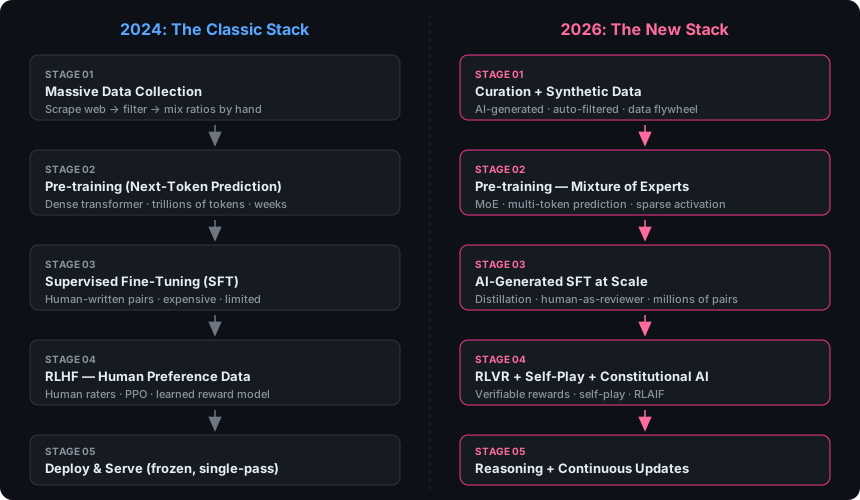
Figure 1 — The 2024 pipeline (left) was linear and human-driven. The 2026 pipeline (right) is cyclic, automated, and self-improving.
A few numbers tell the story: pre-training corpora have passed 15 trillion tokens, over 90% of post-training data is now synthetic (generated by models, not humans), reasoning models use 10–100× more inference compute than their 2024 counterparts, and the dense transformer has been replaced by Mixture of Experts as the default frontier architecture.
The data flywheel
The single most important structural change isn’t in the model — it’s in the training data pipeline. In 2024, you collected data, trained a model, and shipped it. The model was frozen. In 2026, training never really stops: the model generates its own training data, that data is automatically verified and filtered, the model trains on it, gets better, and generates even better data. It’s a flywheel.
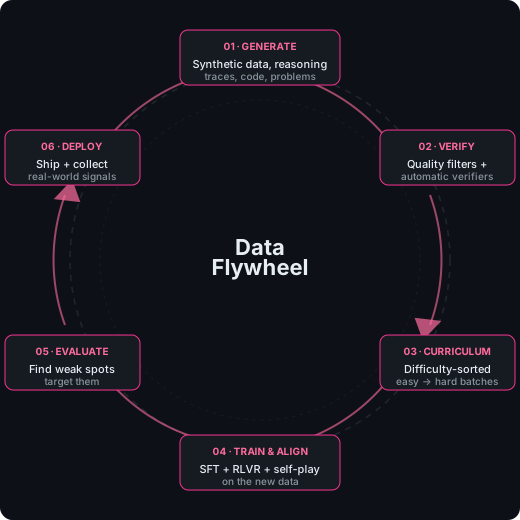
Figure 2 — The data flywheel. Each cycle produces a better model, which produces better data, which trains a better model.
The flywheel has six stages:
- Generate — The frontier model produces synthetic training examples: solved math problems with step-by-step reasoning, code with test suites, logic puzzles with proofs, and problem variations targeting its own weaknesses.
- Verify — Quality classifiers (themselves models) filter the output. Code is compiled and tested. Math answers are checked. Logic proofs are verified. Anything that fails is discarded — no human review needed.
- Curriculum — Verified data is sorted by difficulty. The model starts with easy problems and progresses to harder ones, with the curriculum automatically adjusting based on current performance.
- Train & Align — The model undergoes SFT and RLVR on the new data, reinforced by self-play where two copies debate and the winner’s reasoning is strengthened.
- Evaluate — Run benchmarks, identify weak areas, generate more data specifically targeting those weaknesses.
- Deploy & Collect — Ship the improved model, collect real-world interaction signals, and feed them back into step 1.
The flywheel is the compounding engine. Each cycle produces a better model, which produces better data, which trains a better model. This is why the gap between companies with and without strong existing models keeps widening — you need a good model to start the flywheel, and a better flywheel produces a better model.
Architecture: from dense to sparse
The transformer is still the backbone, but how it’s structured, what it predicts, and how compute is allocated has fundamentally shifted. In 2024, every token activated every parameter — a 400B parameter model used all 400B for every single word it generated. By 2026, Mixture of Experts architectures mean only 2–8 of 64–128 “expert” sub-networks activate per token. A 1 trillion parameter model might use only 30–60B active parameters per token — 3× the knowledge capacity at half the inference cost.
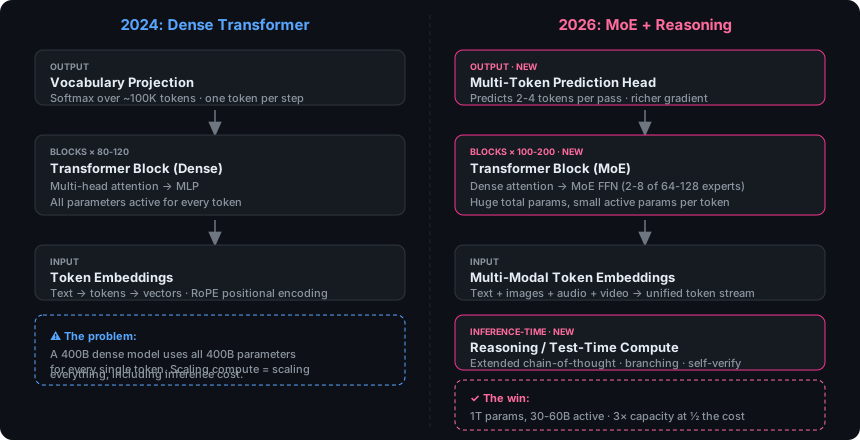
Figure 3 — The 2024 dense transformer (left) activates all parameters per token. The 2026 architecture (right) uses sparse MoE layers, multi-token prediction heads, and an inference-time reasoning layer.
Three architectural changes define the 2026 frontier:
- Mixture of Experts replaces dense MLP layers. A router network selects which experts to use per token. DeepSeek-V3 runs 671B total / 37B active with 256 routed experts. Llama 4 Maverick is 400B / 17B active. Total capacity balloons while per-token compute stays manageable.
- Multi-token prediction replaces single-token next-word prediction. The model predicts 2–4 tokens simultaneously per forward pass, giving a richer training signal and enabling speculative decoding at inference (the model predicts ahead, then verifies in one pass).
- Native multimodality means text, images, audio, and video are processed through one unified token stream from pre-training — not bolted on after the fact with a separate vision encoder.
RLVR: the reward signal that changed everything
Perhaps the single biggest innovation between 2024 and 2026 is RLVR — Reinforcement Learning from Verifiable Rewards. It changed who can train frontier models, and how.
In 2024, alignment used RLHF: humans compared model outputs, a reward model learned from these comparisons, and PPO optimized the model against the learned reward. It worked, but it had hard limits. Human raters are expensive (millions per run), slow (weeks of labeling), inconsistent (20–30% disagreement), and critically, can’t verify correctness on hard math, complex code, or multi-step reasoning. A rater can tell you which response sounds better — not which one is mathematically correct.
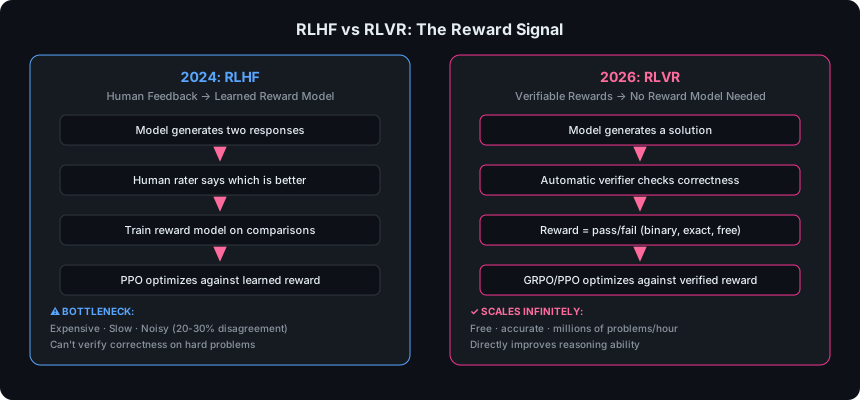
Figure 4 — RLHF (left) requires humans at every step. RLVR (right) replaces the human with an automatic verifier — the reward is binary, exact, and free.
The insight behind RLVR is simple: you don’t need a human to tell you if 2+2=4 is correct — you need a calculator. Scale this to millions of math problems, coding challenges, and logic puzzles, and you get an unlimited, free, perfectly accurate reward signal. The model learns to reason because the reward only fires when the answer is actually correct — not when it sounds good.
Combined with self-play (two copies of the model debate, a judge picks the winner) and process reward models (grade each intermediate reasoning step, not just the final answer), RLVR became the engine that pushed frontier models from “sounds smart” to “actually solves hard problems.”
Test-time compute: the model that thinks
In 2024, a model’s “thinking” happened entirely during training. At inference, it generated one token at a time — left to right, no backtracking, no planning. If a problem was hard, the model couldn’t “try harder.” It gave you its first guess.
By 2026, models think before they answer. The model generates an internal chain of thought — exploring approaches, checking its own work, trying a path, backtracking if it fails, and synthesizing a final answer. Easy questions get answered quickly. Hard questions get more thinking time.
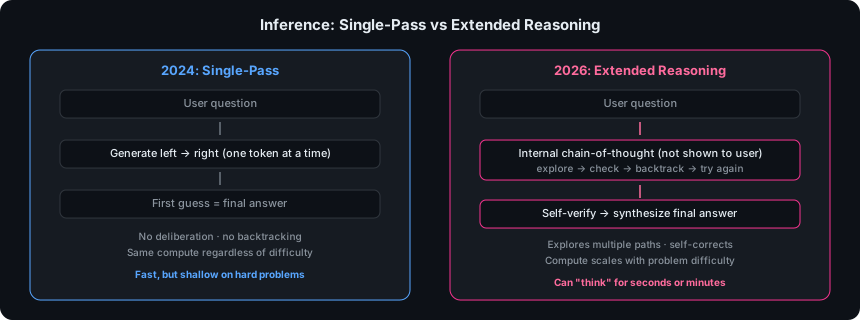
Figure 5 — Single-pass inference (left) gives a first guess. Extended reasoning (right) explores, self-corrects, and verifies before answering.
This isn’t just a bigger model — it’s a fundamentally different way to use it. The training pipeline had to change to support it: the model needs to be trained how to think, not just what to say. RLVR with process reward models teaches it to generate useful reasoning traces. Self-play teaches it to explore alternatives. The result: a model that can tackle problems no single-pass model could solve, by spending more time thinking.
Synthetic data: the model trains itself
The most counterintuitive idea of 2026: the best training data is generated by the model you’re trying to improve.
By 2024, the internet was nearly “used up” as a training data source. High-quality human-written text was already in training sets. Generating more human data is slow and expensive, and the quality of human data plateaued — you can’t hire millions of PhD-level writers to create training examples.
The solution: use existing strong models to generate training data for the next model. A model that’s already good at math generates millions of solved problems with step-by-step reasoning. A model good at coding generates thousands of programming challenges with correct solutions. The new model trains on this synthetic data, and because it was generated by a model that “knows” how to reason, it contains exactly the kind of signal the new model needs.
But wait — doesn’t training a model on its own output cause degeneration? Yes, if done naively. The key innovations: verification (synthetic data is only kept if it passes automatic checks), diversity (generate varied problems, not variations of the same one), curriculum (sort by difficulty, train progressively), and adversarial generation (specifically generate examples the current model fails on). The flywheel isn’t “copy yourself” — it’s “find what you’re bad at, generate practice problems for it, get better, repeat.”
Key concepts in the 2026 vocabulary
| Concept | What it means | Era |
|---|---|---|
| RLVR | Reinforcement Learning from Verifiable Rewards. Automatic correctness checks replace human feedback. | New |
| Test-time compute | Spending extra compute at inference for extended reasoning. The model “thinks” before answering. | New |
| Mixture of Experts | Sparse activation: only 2–8 of 64–128 expert sub-networks fire per token. More capacity, less compute. | Evolved |
| Synthetic data flywheel | Models generate training data for the next model. Verified, filtered, difficulty-sorted. | New |
| RLAIF | Reinforcement Learning from AI Feedback. An AI model evaluates outputs, guided by principles. | Evolved |
| Self-play | Two model copies debate or compete. The winner’s reasoning is reinforced. | New |
| Process reward models | Grade each reasoning step, not just the final answer. Teaches how to reason. | New |
| Multi-token prediction | Train to predict 2–4 tokens ahead, not just one. Richer signal, faster convergence. | New |
| Distillation | Transfer knowledge from a large model to a smaller deployable one. | Evolved |
| Curriculum learning | Automatic difficulty sorting. Easy first, progressively harder. No human needed. | New |
| Continuous training | The deployed model isn’t frozen. New data flows in, RL runs online. | New |
The evolution timeline
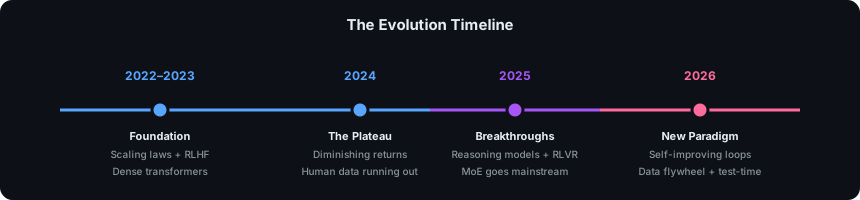
Figure 6 — Frontier model training evolved through four phases: the foundation, the plateau, the breakthroughs, and the new paradigm.
2022–2023: The foundation. Chinchilla scaling laws defined the optimal ratio of parameters to data. RLHF (from ChatGPT) proved that alignment via human feedback works. Dense transformers, next-token prediction, human raters. The playbook was set.
2024: The plateau. Brute-force scaling hit diminishing returns. Human data was running out. Human labelers were expensive and noisy. RLHF produced “helpful-sounding” but not “actually correct” models — sycophancy, where models agreed with users rather than being right. Something needed to change.
2025: The breakthroughs. Three things happened in parallel. Reasoning models (like OpenAI’s o1) showed that test-time compute could dramatically improve performance on hard problems. RLVR proved that verifiable rewards could replace human feedback for reasoning training. Mixture of Experts architectures proved you could have 1T+ parameters with reasonable inference cost. The convergence of these three broke the plateau.
2026: The new paradigm. The insights from 2025 were integrated into end-to-end pipelines. Synthetic data generation, verification, curriculum learning, RLVR, self-play, and test-time reasoning all combined into a self-improving flywheel. Human involvement shifted from “create data and grade outputs” to “design the system and set the objectives.” Models got dramatically better at reasoning, coding, and math — the domains where rewards are verifiable.
The complete picture
| Dimension | 2024 | 2026 |
|---|---|---|
| Architecture | Dense transformer | Mixture of Experts + multi-token heads |
| Training data | Web-scraped + human-written | Mostly AI-generated + verified synthetic |
| Fine-tuning | Human-written SFT examples | AI-generated SFT + distillation |
| Alignment | RLHF (human preference rankings) | RLVR + self-play + RLAIF |
| Reward signal | Learned reward model from humans | Automatic verifiers (tests, math, proofs) |
| Inference | Single-pass, left-to-right | Extended reasoning with test-time compute |
| Human role | Data creators + output raters | System designers + QA reviewers |
| Deployment | Frozen model, periodic retraining | Continuous / online training updates |
| Pipeline | Linear: pre-train → SFT → RLHF → deploy | Cyclic: generate → verify → train → evaluate → repeat |
| Key limitation | Human data supply + reward noise | Verifiable rewards only work in formal domains |
| Multimodal | Text-primary, vision bolted on | Native multi-modal from pre-training |
The factory became an organism
In 2024, training a frontier model was like building a car on an assembly line — linear, human-supervised, static once shipped. By 2026, it’s more like a living system: it generates its own fuel (synthetic data), learns from its environment (verifiable rewards), improves itself continuously (the flywheel), and thinks before acting (test-time compute).
The humans didn’t leave the factory — they moved from the assembly line to the design department. They define what the system should optimize, build the verifiers, and set the curriculum. The system does the rest, endlessly, getting better with every cycle.